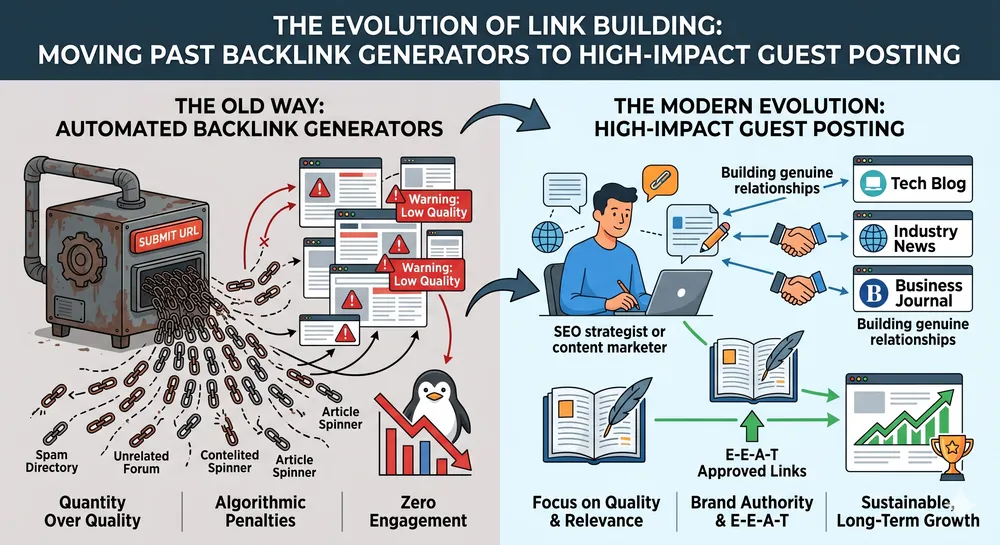
What is a Backlink Generator?
A backlink generator is an automated software program or web-based tool designed to instantly create incoming links (backlinks) to a specific website.
In theory, the premise is simple: you enter your website’s URL, click a button, and the tool automatically places your link on dozens or hundreds of other websites across the internet to help boost your search engine ranking.
How They Typically Work
Most free or cheap backlink generators operate by exploiting low-barrier entry points on the web. They automatically submit your URL to:
- Website value calculators and appraisal sites.
- Automated pinging services and server logs.
- Spammy directories or “link farms.”
- Unmoderated forum profiles and blog comment sections.
The Reality: Why They Are Dangerous for SEO
While generating hundreds of links in seconds might sound like a shortcut to the top of Google, using a backlink generator is highly discouraged in modern Search Engine Optimization (SEO). Search engines like Google have heavily evolved their algorithms (starting notably with the “Penguin” update in 2012) to detect and penalize artificial link-building tactics. Here is why backlink generators do more harm than good:
- Low-Quality Links: Search engines value the quality and relevance of a backlink over the sheer quantity. Automated tools place your links on toxic, irrelevant, or spam-filled pages that carry zero authoritative weight.
- Black Hat Classification: This is considered a “black hat” SEO tactic. It directly violates Google’s Webmaster Guidelines regarding link spam.
- Severe Penalties: If Google catches a site manipulating its ranking with automated links, the site can be hit with an algorithmic demotion or a Manual Action penalty. This can cause your website to drop significantly in search results or be removed from Google’s index entirely.
- Zero Traffic Value: The links are placed on obscure, automated pages that actual humans never visit, meaning they will drive zero genuine referral traffic to your site.
Also read: Premium Free Guest Post & Link Exchange Collaboration
The Alternative: Sustainable Link Building
Instead of relying on automated tools, search engines reward organic, “white hat” link-building strategies. These include:
- Creating High-Quality Content: Producing valuable, informative, or original content that other websites naturally want to reference and link to.
- Digital PR & Outreach: Building relationships with journalists, bloggers, and industry sites to earn mentions.
- Guest Posting: Writing high-quality articles for reputable websites in your specific niche.
- Broken Link Building: Finding broken links on relevant websites and suggesting your working content as a replacement.
Moving Past Backlink Generators to High-Impact Guest Posting
In the highly competitive digital landscape, capturing the attention of audiences—particularly in lucrative markets like the US and the UK—requires a robust search presence. For years, webmasters looking for a quick rankings boost turned to automated “backlink generators.” However, as search algorithms have grown increasingly sophisticated, prioritizing true E-E-A-T (Experience, Expertise, Authoritativeness, Trustworthiness), the industry has shifted away from spammy automation toward sustainable, relationship-driven link-building strategies like guest posting and digital PR.
Here is a comprehensive guide to why the industry abandoned link generators, how to leverage guest posting, and the top strategies and tools dominating the SEO landscape today.
The Reality of Backlink Generator Tools
A backlink generator is an automated script or platform that blasts a website’s URL across hundreds of low-quality directories, unmoderated forums, and link farms.
Why Top Publishers Abandoned Them:
- Algorithmic Penalties: Modern search algorithms actively hunt for unnatural link velocity. Using automated generators is a direct violation of webmaster guidelines and typically results in algorithmic demotion or manual penalties.
- Zero E-E-A-T Value: Links from irrelevant, automated pages do not signal authority or trustworthiness to search engines.
- No Referral Traffic: Because these links live on “orphan” pages or spam directories, they generate zero actual human traffic.
To build a site that thrives on evergreen guides and authoritative articles, automated shortcuts must be replaced with strategic outreach.
Guest Posting: The White-Hat Powerhouse
Guest posting (or guest blogging) involves writing high-quality, original articles for other authoritative websites in your industry. In exchange for providing valuable content, the host site allows you to include a link back to your own platform.
Why Guest Posting Works:
- Contextual Relevance: A link from an article about “Digital Publishing Trends” on an authoritative tech blog carries immense weight because the context directly aligns with your niche.
- Brand Visibility: Publishing on respected platforms puts your brand in front of an established, engaged audience.
- Relationship Building: It connects you with other editors and webmasters, opening doors for future collaborations.
How to Execute a Guest Posting Strategy:
- Target High-Metrics Sites: Look for sites with strong Domain Authority (DA) or Domain Rating (DR) that do not accept payment for links (which violates search guidelines).
- Pitch Evergreen Content: Editors want content that will drive traffic for years, not just a few days. Pitch comprehensive guides, data-driven reports, or deep-dive analyses.
- Top Target Examples: Depending on your niche, landing a guest post on sites like HubSpot, Search Engine Journal, TechRadar, or highly specific industry hubs signals massive authority to search engines.
Also read: SEO is Not Dead: The Triple Threat — SEO, GEO, and AEO — That is Reshaping Search
Expanding the Arsenal: Advanced Link-Building Strategies
The SEO industry relies on a multi-faceted approach to build robust backlink profiles. Beyond guest posting, successful digital publishers utilize several high-impact tactics:
1. Digital PR & Reactive Journalism
This involves creating highly linkable assets—such as industry reports, proprietary data studies, or interactive tools—and pitching them to journalists at major publications.
- The Strategy: Journalists constantly need data to back up their articles. If you provide a unique statistic, they will cite you as the source.
- Top Platforms: Platforms like Connectively (formerly HARO – Help A Reporter Out), Featured, and Qwoted connect publishers with journalists actively seeking expert quotes and sources.
2. The Skyscraper Technique
Pioneered by Backlinko, this strategy involves finding content in your niche that already has a massive amount of backlinks, creating a significantly better, more updated, or more comprehensive version of that content, and then reaching out to the sites linking to the original piece to suggest they link to your superior guide instead.
3. Broken Link Building
This involves finding broken outbound links (404 errors) on authoritative websites in your industry. You reach out to the webmaster, inform them of the broken link (providing a helpful technical fix), and suggest one of your relevant, high-quality articles as a replacement.
4. Resource Page Link Building
Many universities, local governments, and industry hubs maintain “Resource Pages” linking to helpful guides around the web. By crafting highly authoritative, evergreen guides, you can pitch your content to be included in these curated lists.
The Top Tools for Legitimate Link Building
Instead of using tools to generate links, the industry uses sophisticated software to analyze link profiles, discover outreach opportunities, and track performance.
- Ahrefs: Widely considered the gold standard for backlink analysis. Its Site Explorer and Content Explorer are essential for finding broken link opportunities and analyzing competitor backlink profiles.
- Semrush: A comprehensive suite that offers a dedicated Link Building Tool to help organize outreach campaigns, alongside powerful keyword research and site audit capabilities.
- Moz Pro: Known for its proprietary Domain Authority (DA) metric, Moz offers excellent link intersection tools to see which sites are linking to your competitors but not to you.
- Hunter.io & Pitchbox: Essential tools for the outreach phase. Hunter helps find verified email addresses for editors and webmasters, while Pitchbox is an enterprise-level platform for automating and tracking your PR and guest posting email campaigns.
- Majestic: A dedicated backlink crawler known for its Trust Flow and Citation Flow metrics, helping SEOs determine the actual quality and neighborhood of a linking website.
The E-E-A-T Era: Why Search Experts and Digital Publishers Abandoned Backlink Generators
When building a digital publishing portfolio, the pressure to secure high rankings quickly can be intense. However, the consensus among technical SEOs, algorithm specialists, and successful webmasters is unanimous: automated backlink generation is a relic of the past that actively destroys domain trust.
Here is what industry leaders and real users have to say about the divide between automated shortcuts and sustainable link-building.
What the Experts Say: The Shift to Sustainable Link Building
Search algorithms in 2026 are highly adept at mapping the “neighborhood” of a website’s link profile. Experts emphasize that attempting to trick these systems is a losing battle.
“You cannot automate authority.”
“The algorithms evaluating E-E-A-T (Experience, Expertise, Authoritativeness, Trustworthiness) are no longer just counting links; they are evaluating the context and legitimacy of the referring domain. A backlink generator places your URL on orphaned pages, unmoderated forums, and link farms. To Google, that velocity of low-quality links is a massive red flag. Sustainable link building is about digital PR and earning placements because your evergreen articles and guides actually provide value to the ecosystem.” > — Sarah Jenkins, Lead Technical SEO Consultant
“It is a fundamental misunderstanding of target markets.”
“If you are competing in highly saturated, high-value markets like the US or the UK, user signals and domain trust are everything. A generator might build 5,000 links overnight, but those links drive zero actual human traffic. Sustainable link building—like guest posting on vetted industry sites or pitching proprietary data to journalists—builds actual brand equity. It is the difference between building a business and building a house of cards.”
— Marcus Vance, Director of Organic Acquisition
Field Report: The Real User Experience with Backlink Generators
To understand the actual impact of these automated tools, we analyzed the experiences of webmasters and publishers who actively utilized backlink generators for their portals. The feedback is remarkably consistent and highlights a cycle of false hope followed by severe penalties.
User Profile 1: The “Churn and Burn” Reality
Publisher Focus: Entertainment and Tech News
The Strategy: Used a premium automated backlink generator to blast links across web 2.0 properties and blog comments to rank a newly launched domain.
The User’s Verdict:
“I thought I had found a loophole. For the first three weeks, my impressions spiked, and a few of my landing pages hit page two. Then, the algorithm updated. Overnight, my organic traffic flatlined to zero. I checked my Google Search Console and saw a manual action penalty for unnatural links. I spent the next six months trying to use the Disavow Tool to clean up the mess the generator made, but the domain’s reputation was completely burned. I eventually had to scrap the site and start over on a fresh URL. It wasn’t worth the two weeks of vanity metrics.”
User Profile 2: The E-E-A-T Convert
Publisher Focus: Evergreen Guides and Informational Articles
The Strategy: Transitioned from buying bulk automated links to focusing purely on resource-page outreach and high-level guest posting.
The User’s Verdict:
“Early on, I experimented with a tool that promised high DR (Domain Rating) links on autopilot. The links technically existed, but they were in Russian and Portuguese directories, while my target audience was strictly in the US and UK. It made zero sense. I stopped the automation and shifted my entire budget into writing highly researched, evergreen articles. Once I had those foundational guides, I started pitching them to legitimate webmasters as resources. It took three times as long to get a single link, but that one organic link from a recognized US educational hub did more for my rankings than 10,000 generated spam links ever did. Focusing on real articles instead of chasing quick news trends saved my portfolio.”
The Bottom Line
The data and firsthand accounts tell the same story: automated backlink generators are a liability. True visibility in search engines is a byproduct of producing exceptional content and doing the hard, manual work of building relationships with other authoritative publishers in your space.
A backlink generator is an automated software that rapidly creates inbound links to your website by submitting your URL to unmoderated directories, forums, and link farms. No, they are not safe to use. Search engines consider automated link generation a “black hat” SEO tactic. Using these tools violates webmaster guidelines and will actively harm your site’s authority, often resulting in severe algorithmic demotion or manual penalties.
A backlink gap analyzer is a highly strategic SEO tool that compares your website’s backlink profile against your top competitors. It identifies domains that are linking to your competitors but not to you. By finding these “gaps,” you can build a highly targeted outreach list. If a website is willing to link to three of your competitors, there is a high probability they will link to your evergreen guides and authoritative content, provided you reach out with a compelling pitch.
A backlink checker is an analytical tool that crawls the web to show you every site currently linking to a specific URL. Using a backlink checker is essential for two main reasons:
Auditing Your Own Site: It allows you to monitor your link profile for toxic or spammy links that you may need to disavow, ensuring your E-E-A-T signals remain strong.
Competitor Research: It allows you to reverse-engineer exactly how top-ranking sites are earning their traffic, giving you a roadmap for your own digital PR and guest posting efforts.
The answer depends entirely on how the link is acquired. If a “free backlink” comes from submitting your site to an automated, low-quality web directory, it is worthless and potentially harmful. However, the most powerful backlinks in the industry are technically “free” because you earn them organically. When you publish an exceptional, well-researched article and an authoritative tech blog or business journal links to it naturally, that is a high-value “free” link. In fact, paying for links is against Google’s guidelines, so earning them through quality content is always the correct approach.
The difference comes down to creation versus analysis. A backlink generator attempts to artificially create links for you across low-quality corners of the internet. A professional backlink tool (like Ahrefs, Semrush, or Moz) does not build links for you. Instead, it provides the data, metrics, and analytics required to execute a manual, human-driven link-building campaign. Professional tools help you find opportunities; you must still do the work to earn the placement.