For years, link building was synonymous with the relentless grind of manual outreach. Thousands of cold emails. Dismal open rates. Endless follow-ups. It was a numbers game that drained agency resources and yielded unpredictable returns.
Then came the marketplaces.
Acting as digital matchmakers between website owners and search engine optimization (SEO) strategists, guest posting marketplaces have fundamentally rewired how the internet’s backlink economy operates. They have replaced the cluttered inbox with the streamlined dashboard. But underneath the convenience lies a complex ecosystem of vetting protocols, pricing tiers, and shifting search algorithms.
Here is exactly how these platforms function, why top-tier SEO experts use them, and how the market is adapting to the realities of search in 2026.
How Guest Posting Marketplaces Actually Work
At their core, guest blogging platforms operate as centralized clearinghouses for digital PR and backlink acquisition. They eliminate the friction of negotiation.
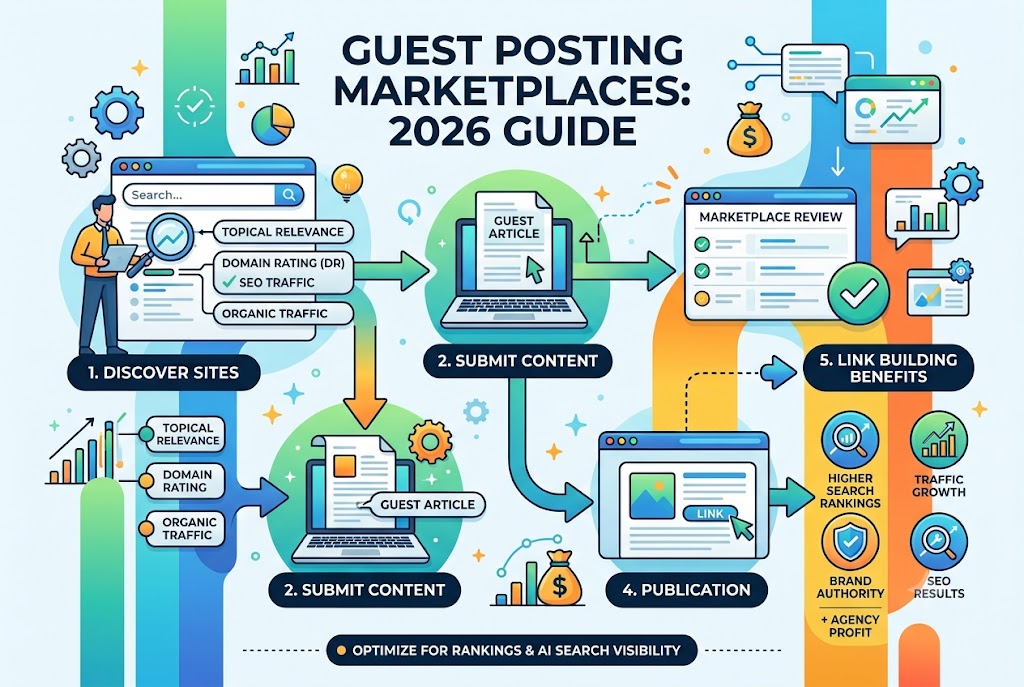
Instead of pitching a publisher blind, an SEO strategist simply logs into a platform. The process is brutally efficient and highly structured:
The Core Mechanics: From Browsing to Publishing
- Filtering the Inventory: Users search databases containing thousands of pre-vetted domains. They filter by highly specific metrics, including Domain Rating (DR), Semrush Authority Score (AS), geo-distribution, and specific industry niches.
- Reviewing the Data: The best platforms integrate live API data from third-party tools. This allows buyers to instantly verify a site’s organic traffic trends and audience location before spending a dime.
- Purchasing and Fulfillment: The user selects a domain, uploads their content (or orders professional writing directly through the platform for an extra fee), and hits submit. Turnaround times typically range between 7 to 21 days for standard editorial placements.
It is self-serve PR. You know exactly what you are paying for, and the publisher knows exactly what is expected.
Also read: How to Find Free & Low-Cost Guest Posting Sites (DA 20+) in 2026
Why SEO Experts Rely on Marketplaces in 2026
Why do SEO veterans willingly pay marketplace premiums rather than sending their own emails? The math is undeniable.
Data from Ahrefs indicates that the average cost to build a single backlink through internal staff outreach exceeds $300 in pure labor. That figure factors in prospecting, writing pitches, negotiating, and following up. Marketplaces compress that cost entirely.
For agencies, these platforms offer a highly lucrative white-label model. According to recent industry pricing breakdowns from Link Publishers, an agency might purchase a mid-tier placement for $50 to $72. They then package that link into a broader SEO retainer, billing the client anywhere from $250 to $400. This secures a profit margin of $150 to over $300 per single link. Multiply that by dozens of clients, and the recurring revenue easily covers operational overhead while driving significant agency growth.
At the extreme high end, premium marketplace placements on major publications—think global news outlets like CNET—can carry price tags surpassing $50,000.
Shifting Priorities: AI Search and The GPQS Framework
The strategy behind buying links has evolved. In 2026, dropping a link onto a random, high-DR site with zero relevance is a surefire way to waste money. The industry has matured, and the focus has shifted strictly to editorial context.
The Rise of AI Visibility
Search is no longer just about traditional blue links. Marketplaces are increasingly leaning into “AI SEO.” Platforms like SayNine explicitly note that building a high-authority backlink profile doesn’t just improve domain authority—it directly influences Large Language Models (LLMs). The more frequently a brand is contextually mentioned across trusted, niche-relevant industry sources, the more likely models like ChatGPT, Claude, and Perplexity are to recommend that brand in AI-generated answers.
The Guest Post Quality Scoring (GPQS) Framework
To combat the influx of low-quality Private Blog Networks (PBNs) and link farms, modern SEO experts apply strict vetting. A recent analysis by Xamsor Blog, which reviewed 121 different guest posting platforms to create a 2026 worldwide rating, found a startling reality: immense size does not equal quality. Some platforms boast over 100,000 publishers, but an alarming number of those are low-tier link donors.
To filter the noise, experts rely on strict validation frameworks. The primary rule? Traffic verification. If a marketplace cannot provide transparent, real-time Ahrefs or Semrush organic traffic data, it is a liability. Furthermore, top strategists demand topical relevance. The publishing domain must share primary keyword categories with the target website. A backlink from a finance blog to a fitness product holds little to no weight in modern algorithms.
Navigating the 2026 Marketplace Roster
Choosing the right platform depends entirely on the scale and style of the campaign.
- FATJOE and The HOTH: Built for heavy volume. These are productized, reliable vendors heavily utilized by agencies needing fast, repeatable fulfillment and white-label reporting.
- SayNine and Authority Builders: Known for deeper analytical filtering, offering robust dashboards where users can hand-pick domains based on verified traffic and strict editorial relevance.
- Link Publishers: Highly regarded for transparent, large-scale agency placements, providing a massive catalog with clear domain metrics and white-label margins.
The link-building ecosystem is no longer a dark art. It is a highly systematized marketplace driven by verified traffic data, algorithmic relevance, and the overarching need to establish brand authority across both traditional search engines and emerging AI platforms.
Sources Quoted:
- Ahrefs (via Stay Digital Marketers): Provided data on the $300+ staff time cost of manual outreach.
- Link Publishers: Sourced for agency margin economics, white-label pricing, and platform features.
- SayNine: Cited regarding AI SEO visibility (ChatGPT, Claude) and self-serve dashboard mechanics.
- Xamsor Blog: Sourced for their 2026 worldwide rating analysis of 121 guest posting marketplaces and the pitfalls of massive publisher counts.